
- tusemezane@kikwetusacco.com
- +254 704 895 555
- Your reliable Sacco Partner |
- X
Understand the difference between open and closed SACCOs in Kenya, their benefits, requirements, and how to choose the right SACCO for you.
Many people don’t understand the different types of SACCOs in Kenya.
They join one, only to realise later that it doesn’t fit their needs.
Choosing the wrong type can affect your loan access, membership flexibility, and even your savings growth.
In this guide, you’ll learn:
The difference between open and closed SACCOs
Examples of each
Advantages and disadvantages
How to choose the right one for your situation
Let’s start with the basics.
A SACCO (Savings and Credit Cooperative Organisation) is a member‑owned financial institution.
Members pool their savings and offer loans to each other at affordable rates.
SACCOs in Kenya are regulated by SASRA (Sacco Societies Regulatory Authority).
They fall into two main categories: open and closed.
👉 For a complete overview, read our [Complete Guide to SACCOs in Kenya].
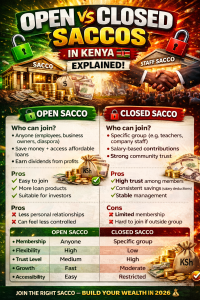
What is an open SACCO?
An open SACCO is a cooperative that allows membership from the general public without strict employment or group restrictions. Anyone who meets the basic requirements can join.
Membership is open to the public
Not tied to a specific employer or profession
Flexible eligibility criteria
Often community‑based or regional
Community‑based SACCOs (e.g., residents of a specific area)
Public membership SACCOs (e.g., Kikwetu Sacco – open to all Kenyans)
Market traders’ SACCOs (open to anyone in that trade)
✅ Easy to join – no employer sponsorship needed
✅ Flexible eligibility – suitable for entrepreneurs, freelancers, and self‑employed individuals
✅ Wider access to financial services
✅ You can stay a member even if you change jobs
❌ May have less structured savings discipline
❌ Loan approval may require stronger guarantors
❌ Sometimes slower growth due to diverse membership
💡 Kikwetu Pro Tip: If you are self‑employed, run a business, or change jobs frequently, an open SACCO like Kikwetu is your best choice.
What is a closed SACCO?
A closed SACCO is restricted to members of a specific group, such as employees of a particular company, organisation, or profession. Membership is not open to the general public.
Membership limited to a specific employer or association
You must belong to that group to join
Often has a stable, predictable savings base
May offer employer‑deducted loan repayments
Employer‑based SACCOs (e.g., Kenya Power SACCO, Safaricom SACCO)
Teacher SACCOs (e.g., Kenya Union of Teachers SACCO)
Professional group SACCOs (e.g., doctors, lawyers, pilots)
✅ Strong member trust and discipline
✅ Stable contribution base (salaries deducted automatically)
✅ Often faster loan approval (employer guarantee)
✅ Lower risk of default (due to salary check‑off)
❌ You cannot join unless you work for that employer
❌ If you leave the job, you may have to exit or transfer
❌ Less flexibility for non‑salaried individuals
💡 Kikwetu Pro Tip: If you are a salaried employee with a stable job and your employer offers a SACCO, a closed SACCO can be very convenient. However, you lose access if you resign.
What is the difference between open and closed SACCOs?
Open SACCOs allow anyone to join, while closed SACCOs restrict membership to a specific employer, profession, or group. Open SACCOs offer flexibility; closed SACCOs offer structure.
Here’s a detailed comparison table:
| Feature | Open SACCO | Closed SACCO |
|---|---|---|
| Membership | Open to general public | Restricted to a specific group |
| Eligibility | Flexible (any Kenyan) | Must belong to employer/profession |
| Entry | Easy – join anytime | Limited – only if you work there |
| Best for | Self‑employed, freelancers, business owners | Salaried employees |
| Loan repayment | Can be via M‑Pesa or standing order | Often via salary check‑off |
| If you leave job | You remain a member | You may lose membership |
| Growth base | Broad, diverse membership | Controlled, stable group |
| Examples | Kikwetu Sacco, community SACCOs | Kenya Power SACCO, teachers’ SACCOs |
There is no single “best” SACCO type in Kenya.
The right choice depends on your personal situation.
| If you are… | Recommended SACCO type |
|---|---|
| Self‑employed, freelancer, or business owner | ✅ Open SACCO (e.g., Kikwetu) |
| Salaried employee with employer SACCO | ✅ Closed SACCO (for payroll deductions) |
| Seeking flexibility to join/leave | ✅ Open SACCO |
| Wanting automatic loan repayment | ✅ Closed SACCO (check‑off system) |
| Planning to change jobs soon | ✅ Open SACCO (membership continues) |
| Wanting community and wide loan products | ✅ Open SACCO |
💡 Kikwetu Pro Tip: Many members actually belong to both – a closed employer SACCO for payroll savings and an open SACCO like Kikwetu for extra flexibility and higher loan limits.
Follow these steps to make the right decision.
Can you join?
Open SACCOs are easier. Closed SACCOs require employment or group membership.
How easy is it to get a loan?
Open SACCOs may need guarantors or savings history.
Closed SACCOs often use salary check‑off.
SACCO loan rates vary.
Use our SACCO Loan Interest Rates in Kenya guide to compare.
Always choose a SASRA‑regulated SACCO.
This ensures your money is protected.
Some SACCOs require monthly minimum savings.
Open SACCOs like Kikwetu are more flexible.
Talk to existing members.
Ask about withdrawal delays, loan approval times, and customer service.
❌ Joining a closed SACCO without understanding exit rules – you may lose benefits if you leave your job.
❌ Assuming all open SACCOs have the same loan terms – compare first.
❌ Ignoring regulation status – unlicensed SACCOs are risky.
❌ Choosing based only on proximity – online and mobile access now matters more.
❌ Not checking loan policies – some SACCOs have long waiting periods.
Open SACCOs allow membership from the general public with no employment restrictions. Closed SACCOs limit membership to employees of a specific company or members of a particular profession.
Yes, subject to basic requirements such as a minimum initial deposit, a valid ID, and completing a membership form. No employer sponsorship is needed.
Not necessarily. Closed SACCOs offer structure and payroll deductions, which suit salaried employees. Open SACCOs offer flexibility and are better for self‑employed individuals or those who change jobs often.
There is no single best type. Choose an open SACCO if you want flexibility and public access. Choose a closed SACCO if you are a salaried employee with an employer‑sponsored plan.
Yes, many Kenyans belong to both. For example, you might use your employer’s closed SACCO for automatic savings and an open SACCO like Kikwetu for additional loan options.
This article connects to your existing content:
Related posts:
Looking for a flexible SACCO with accessible membership and strong loan products?
Kikwetu Sacco is an open SACCO – anyone in Kenya can join.
We offer:
✅ Easy membership via M‑Pesa
✅ Competitive loan rates (reducing balance)
✅ Wealth Vault savings that earn interest
✅ Shares and dividends for long‑term growth
👉 [Join Kikwetu SACCO Now]
👉 Learn More About Our Loans
👉 Apply for a Loan Today
Last Updated: April 09, 2026
Reviewed by Kikwetu Sacco Financial Team
This content has been reviewed by the Kikwetu Sacco Financial Team, a group of professionals with experience in SACCO lending, savings management, and financial literacy in Kenya. The review ensures the information is accurate, practical, and aligned with current credit and loan practices.
Join us today and start growing your money the smart way.


Your funds are safely stored with Kikwetu Sacco.


We prioritize superior service in all our interactions.


Access loans at lower rates than traditional banking institutions.


As part of a shared-goal community, members benefit from collective support.


We emphasize savings discipline, especially for Kenyan youth.


Members can save and borrow to invest in land, up to three times their saved amount.