
- tusemezane@kikwetusacco.com
- +254 704 895 555
- Your reliable Sacco Partner |
- X
Compare SACCOs and microfinance institutions in Kenya. Learn the key differences, loan terms, interest rates, and which option is best for you.
When you need a loan or a place to save, the choices can be confusing.
Two popular options in Kenya are SACCOs and microfinance institutions.
Both offer access to credit. However, they operate very differently.
Choosing the wrong one could cost you more money or limit your financial growth.
In this guide, you’ll learn:
What a SACCO is and how it works
What a microfinance institution (MFI) is
The key differences between SACCO vs microfinance institutions in Kenya
Loan terms, interest rates, and which is cheaper
How to choose the best option for your situation
Let’s start with the basics.
What is a SACCO?
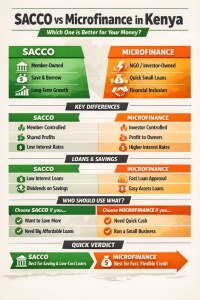
A SACCO (Savings and Credit Cooperative Organization) is a member‑owned financial institution where individuals pool their savings and access loans based on their contributions. Profits are shared among members as dividends.
✅ Member‑owned – you have a say in how it’s run.
✅ Savings first – you must save before borrowing.
✅ Loan based on savings – typically 3 to 5 times your savings.
✅ Dividends – you earn a share of the profits annually.
✅ Lower interest rates – usually 1% per month (reducing balance).
👉 For a complete overview, read our [Complete Guide to SACCOs in Kenya](link to pillar page).
A microfinance institution is a financial organization that provides loans and other financial services to individuals and small businesses, especially those without access to traditional banks. MFIs are not member‑owned; they are owned by investors or founders.
✅ No ownership – you are a customer, not an owner.
✅ Loan based on creditworthiness – not necessarily savings.
✅ Faster approval – often within hours or days.
✅ Higher interest rates – typically 15–40% annually or more.
✅ No dividends – profits go to the institution.
What is the difference between SACCOs and microfinance institutions?
SACCOs are member‑owned and require savings before borrowing; they offer lower interest rates and pay dividends. Microfinance institutions are company‑owned, lend based on creditworthiness, charge higher interest, and do not share profits.
Here’s a detailed comparison table:
| Feature | SACCO (e.g., Kikwetu) | Microfinance Institution |
|---|---|---|
| Ownership | Member‑owned | Company/organisation‑owned |
| Profit distribution | Shared as dividends | Retained by institution |
| Loan basis | Based on your savings | Based on creditworthiness / income |
| Interest rates | Low (~1% monthly, reducing balance) | Higher (15–40%+ annually) |
| Membership required | Yes (must join and save) | No (anyone can apply) |
| Guarantors | Often required | Not always required |
| Savings required | Yes, before borrowing | No |
| Dividends | Yes, paid annually | No |
| Regulation | SASRA (for deposit‑taking) | Central Bank of Kenya |
| Best for | Long‑term growth, affordable loans | Short‑term, quick cash |
You must save consistently first.
Loan amount is typically 3–5 times your savings.
Guarantors are often required.
Interest is low (reducing balance).
Repayment periods are longer (months to years).
No savings required.
Loan approval is based on your income or business cash flow.
Guarantors are not always needed.
Interest rates are much higher.
Repayment periods are shorter (weeks to months).
💡 Kikwetu Pro Tip: If you need a large loan for land, school fees, or business expansion, a SACCO is far cheaper. Only use microfinance for very short‑term, urgent needs.
Which is cheaper, SACCO or microfinance?
SACCO loans are generally cheaper. SACCOs charge around 1% per month (12–14% annually) on a reducing balance. Microfinance institutions charge 15–40% or more annually, often with flat rates or hidden fees.
| Institution Type | Interest Rate | Total Interest | Total Repayment |
|---|---|---|---|
| SACCO (reducing balance) | 1% monthly | ~KES 3,300 | ~KES 53,300 |
| Microfinance (flat rate) | 2% monthly | ~KES 12,000 | ~KES 62,000 |
The microfinance loan costs nearly four times more in interest.
✅ Lower loan interest rates – save thousands over time.
✅ Earn dividends on your savings – passive income.
✅ Higher borrowing limits as you save more.
✅ Community‑based financial growth – you’re an owner.
✅ Build a strong credit history for future loans.
✅ Quick loan access – sometimes within hours.
✅ No need for long‑term savings first.
✅ Flexible eligibility – business owners and informal workers qualify.
✅ Ideal for urgent, small, short‑term needs.
❌ Must save before borrowing – not helpful if you have no savings.
❌ Guarantors often required – can be hard to find.
❌ Loan approval takes longer – days to weeks.
❌ You may need to attend meetings or AGMs.
❌ Very high interest rates – can trap you in debt.
❌ No ownership or dividends – profits go elsewhere.
❌ Risk of over‑indebtedness – easy to borrow more than you can repay.
❌ Short repayment periods – weekly or daily payments can strain cash flow.
There’s no single answer.
The best choice depends on your situation.
| If you… | Best option |
|---|---|
| Have stable income and can save monthly | SACCO (lower cost, long‑term growth) |
| Need cash urgently and have no savings | Microfinance (fast, but expensive) |
| Want to build wealth over time | SACCO (dividends and ownership) |
| Run a small business with irregular cash flow | Microfinance for short‑term, but also join a SACCO for savings |
| Are a first‑time borrower with no credit history | Microfinance may be easier, but SACCO is better long‑term |
💡 Kikwetu Pro Tip: Many successful people use both. They keep savings and long‑term loans in a SACCO, and only use microfinance for true emergencies.
❌ Taking repeated microfinance loans for everyday expenses – the interest will drain you.
❌ Joining a SACCO without understanding the savings and guarantor requirements.
❌ Ignoring the total loan cost – a low monthly payment can hide high total interest.
❌ Borrowing from multiple microfinance lenders at once – leads to a debt spiral.
❌ Not comparing interest calculation methods (reducing balance vs flat rate).
SACCOs are member‑owned cooperatives that offer loans based on savings, charge lower interest, and share profits as dividends. Microfinance institutions are company‑owned, lend based on creditworthiness, charge higher interest, and keep profits.
SACCOs are much cheaper. Their interest rates are typically 1% per month (reducing balance), while microfinance rates can be 15–40% or more annually.
Yes, many people do. Use the SACCO for long‑term savings and affordable loans, and microfinance only for urgent, short‑term needs.
Not always. Many rely on your income, business cash flow, or mobile money history instead of guarantors.
For short‑term working capital, microfinance is faster. However, for long‑term growth and lower costs, join a SACCO and save consistently.
Yes, microfinance loans are easier to get because they don’t require savings or guarantors. However, the high interest makes them expensive.
Unlike microfinance institutions, Kikwetu Sacco offers:
✅ Lower interest rates – 1% per month, reducing balance.
✅ Member ownership – you earn dividends on your savings.
✅ Higher borrowing power – up to 3 times your savings.
✅ Flexible digital access – save and apply for loans via M‑Pesa.
✅ SASRA regulated – your money is safe.
👉 Whether you’re salaried, self‑employed, or a business owner, Kikwetu helps you grow financially without the high cost of microfinance.
Stop paying high microfinance interest.
Start building wealth with a SACCO.
 [Join Kikwetu SACCO Now] – start saving and borrowing today.
Last Updated: April 14, 2026
Reviewed by Kikwetu Sacco Financial Team
This content has been reviewed by the Kikwetu Sacco Financial Team, a group of professionals with experience in SACCO lending, savings management, and financial literacy in Kenya. The review ensures the information is accurate, practical, and aligned with current credit and loan practices.
Join us today and start growing your money the smart way.


Your funds are safely stored with Kikwetu Sacco.


We prioritize superior service in all our interactions.


Access loans at lower rates than traditional banking institutions.


As part of a shared-goal community, members benefit from collective support.


We emphasize savings discipline, especially for Kenyan youth.


Members can save and borrow to invest in land, up to three times their saved amount.